

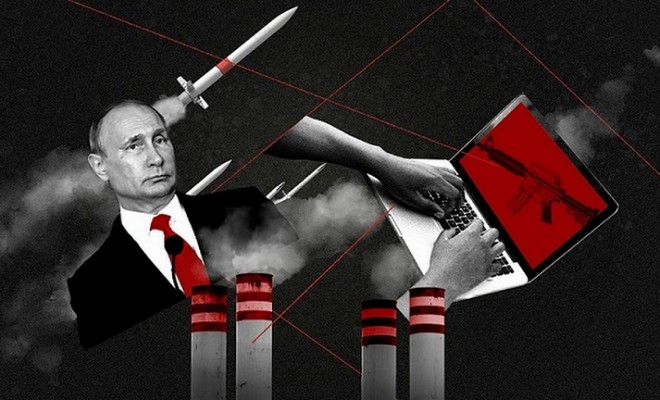
Global threats multiply
Officials who have held America’s top national security positions tell “Axios on HBO” that the nation has never before faced such a tangled web of threats — and they worry about the government’s capacity to confront them.
- David Petraeus, former CIA director and retired four-star general, and R. McMaster,former national security adviser, both name the rivalries with Russia and China as the greatest threats of our time.
- Janet Napolitano,former Homeland Security secretary, lists climate change, cyberattacks and gun violence.
- Leon Panetta, former CIA director and Defense secretary, is most concerned about cyber threats.
- Lisa Monaco,former White House homeland security adviser, says her biggest fear is a deadly pandemic.
The big picture: The last time the global threat picture was this crowded and combustible was in the lead-up to World War I, Panetta says.
- Between the lines … Some of the threats are familiar: Russia, nukes, terrorism. But many are exacerbated by new technologies — from AI-powered weapons to viral hatred on social media — and by climate change.
• Russia and China form a front
Security officials increasingly view Russia and China — separately and together — as a threat to U.S. security.
Between the lines: “What I consider two of our strongest adversaries are now working together to try to undermine stability in the United States of America,” Panetta says. “This is not like dealing with some kind of rogue nation.”
- “They have greatcyber capabilities. They have capabilities in space and on missiles. They both have very strong military capabilities,” Panetta tells “Axios on HBO.” (See a clip.)
- “Their cooperation… is a very dangerous moment for the United States of America.”
Zoom out: Russia and China aren’t formal allies but they are de factoallies.
- They share about 2,600 miles in border.
- Chinese PresidentXi Jinping and Russian President Vladimir Putin have emphasized their newfound cooperation through steps trivial (flipping pancakes together) and substantial (joint military exercises and a linked oil-and-gas system).
- As both McMaster and Petraeuspoint out, both countries have suffered serious economic blows from U.S. sanctions and tariffs.
Our thought bubble, per future editor Steve LeVine: Smart U.S. policy will attempt to create discord between Russia and China through carrot and stick.
- A major blunderwould be pushing too hard with financial punishments, and incentivizing Moscow and Beijing to bypass the U.S. trade and monetary order.
- When the dollar’s primacymaterially dwindles, that will be game over in balance of power with the East.
• Global hotspots: North Korea and Iran
Two of the countries where the threat of direct military conflict with the U.S. is greatest are Iran and North Korea.
Threat level: H.R. McMaster, who until last April was involved in the most sensitive discussions on those countries with President Trump, warns it’s “difficult to overstate the threat from a nuclear North Korea.”
The big picture: McMaster argues North Korea could directly threaten “the United States, China, Japan, the world” with its nuclear arsenal and could also engage in “nuclear blackmail.”
- McMaster also points tothe risk of wider nuclear proliferation in Japan, South Korea and beyond, asking: “If North Korea gets a weapon, who doesn’t?”
Meanwhile, the administration has focused its ire on Tehran.
- McMaster placesIran on the list of the greatest global threats because of its support for groups the U.S. has designated as violent proxies and terror groups.
- His successoras national security adviser, John Bolton, has increased the pressure on Iran further still, warning of “unrelenting force” if Iran or its proxies strike U.S. interests.
- That has ledto a fear that tensions could spill over into military conflict, even though Trump and Iranian leaders have both said they don’t want a war.
• The pandemic potential
Another global threat — one that is a repeated refrain amongst the White House, Centers for Disease Control, former national security advisers and even Bill Gates — is a pandemic.
Between the lines: Influenza is of particular concern for health officials, even though there are more contagious viruses — for example, measles — and more deadly ones, like Ebola.
- But the flu viruscan mutate quickly, sometimes acquiring a new ability to infect humans easily, causing concern about its potential to spark a pandemic, which happens when a new strain appears that most have no immunity against.
“The combination of a new deadly strain of flu plus air travel plus the ease with which it can be transmitted to other people. That really is the worst case scenario.”
— Lisa Monaco, on “Axios on HBO”
Our thought bubble, from Axios’ Eileen Drage O’Reilly: Emerging virulent pathogens are a threat each nation needs to report on a transparent basis to promote possible global coordination to halt their spread.
Πηγή: axios.com


