

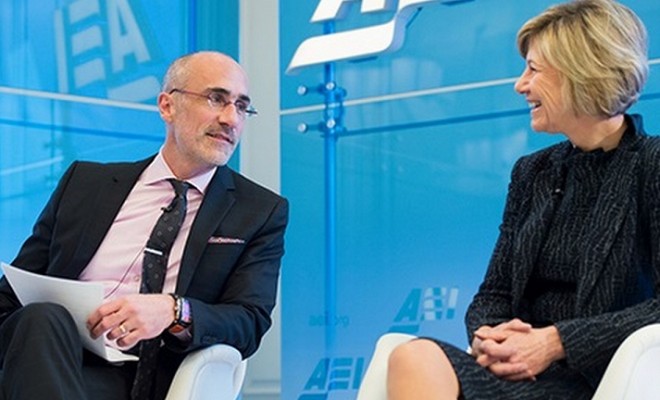
A conversation with Sue Desmond-Hellmann, CEO of the Bill & Melinda Gates Foundation
Desmond-Hellman of the Gates Foundation stressed that globalization makes possible a kind of international attention, neighborliness, and care for others that “opens your eyes and lifts up your spirit”.
Dr. Sue Desmond-Hellmann, CEO of the Bill and Melinda Gates Foundation, runs the largest foundation “in the history of the universe” (according to Arthur Brooks). Her talk with Brooks at AEI this week revealed, however, that she and the Foundation think big by seeing the small details. Desmond-Hellmann, who pioneered gene-targeted cancer therapies at Genentech, shared how her father, a retail pharmacist, and his “magical” way of tacking health problems alongside the family doctor inspired her to take up medicine. She was drawn to oncology’s blend of the focused — studying the cell – with the broad, big picture awareness and bedside skills necessary to meet the needs of suffering individuals and families. Similarly, precision medicine – on which she has a TED talk— Desmond-Hellmann believes offers a targeted, data-driven, and mindful approach to “bring big data to better understanding specific problems.” Aligning private sector dynamism and data collection strategies with practical health problems can reveal “the right intervention for the right population, in the right community”, whether the challenge is breast cancer in America or the millions of neonatal deaths globally.
She elaborated that the Gates Foundation, as it looks to catalyze changes in global inequity, recognizes different treatments work differently for different patients. “Everyone, no matter where in the world, should have a chance at a healthy and productive life.” In Africa, for example, it means improving agriculture and access to health care. In the United States, it means a focus on improving and diversifying educational options, providing teachers with “what they need to prosper”, and guaranteeing certain common educational outcomes for all public school students. Again, overarching goals can be in tension with specific local problem-solving, and she gestured to the Foundation’s endorsement of Common Core as one issue where a vision of standardization and equity conflicted with some communities’ desires. But the Gates Foundation and Desmond-Hellmann’s approach suggest such tension is itself productive for coming up with better solutions: “We’re all in on education, for the long haul. We’ve learned a lot.”
Brooks challenged her to name a disappointment; her answer, a moment when balancing detail with the big picture failed, namely the return of polio to Nigeria this August. No matter how much data you collect, you can miss something and suffer a “big setback” when you believed you had the endgame. “Surveillance let us down,” she said, a reminder all diagnoses must be revaluated to make sure they don’t reflect ignorance of a different problem.
Given the foundation’s global reach, Brooks had her comment on political pushback against globalization. She stressed that globalization makes possible a kind of international attention, neighborliness, and care for others that “opens your eyes and lifts up your spirit”. When an audience member asked her to offer guidance to President-elect Trump, in a similar spirit she responded that a “health crisis anywhere is a health crisis everywhere.” Eventually Desmond-Hellman couldn’t avoid a medical play on words. Generosity is contagious, she closed, and you needn’t be the Gates to catalyze real problem-solving by being generous with your money, time, and attention.
Πηγή: American Enterprise Institute


