From the “Mediterranean NATO” Concept to a Polycentric Alliance System
The Eastern Mediterranean as a Core Node of a New Global Stability Architecture
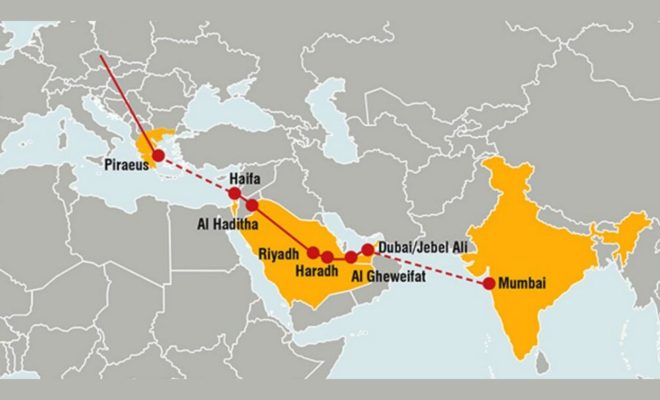
Geopolitical transformations rarely emerge as formal institutional announcements. They begin as converging perceptions, strategic necessities, and shared threat assessments — and only later crystallize into political action. This is precisely what is unfolding today with the vision articulated by Israeli Prime Minister Benjamin Netanyahu, who outlined the creation of a networked system of allied states — a proposed “hexagon of alliances” — designed to act collectively against destabilizing extremist axes across the broader region.
The explicit positioning of Greece and Cyprus as core pillars, alongside Israel and India under the leadership of Prime Minister Narendra Modi, reveals something deeper than a new set of partnerships. It signals the emergence of a systemic geopolitical architecture — not bilateral diplomacy, not ad hoc cooperation, but structured strategic alignment.
The idea that preceded political reality
Even before this strategy was officially formulated, a core concept had been established: the need to create a trans-regional collective security mechanism in the Eastern Mediterranean — a functional ‘NATO within NATO’, as first reported and supported by mywaypress.gr in a related article.
Not as institutional rupture, but as complementary deterrence architecture in spaces where internal alliance constraints inhibit effective action.
The logic was structurally simple:
when institutions are paralyzed by internal balances,
when alliances cannot deter internal revisionism,
when strategic inertia replaces deterrence,
aligned actors self-organize.
What was once conceptual is now becoming political reality.
Not in opposition to the United States — but strategically compatible
The emerging framework does not contradict the United States. On the contrary, it aligns with the deeper logic of contemporary American grand strategy.
U.S. strategic thinking has shifted away from:
- centralized global management,
- universal military presence,
- monolithic alliance structures.
The emerging model is based on:
networks of aligned states
decentralized security provision
regional stability clusters
This architecture:
- reduces U.S. operational burden,
- increases regional stability,
- allows strategic focus on priority theaters.
And the primary systemic challenge today is not the Mediterranean.
It is China.
Strategic reordering of global priorities
Since the Trump era under Donald Trump, a structural reality has become clear:
Europe is no longer the central strategic priority.
The Eastern Mediterranean is not a primary theater of power competition.
The Indo-Pacific is the main axis of systemic rivalry.
As a result, regions outside the primary strategic focus must develop autonomous stability mechanisms — not in opposition to U.S. leadership, but in strategic complementarity with it.
The emerging alliance system:
- does not compete with NATO,
- does not undermine U.S. influence,
- does not form a rival power bloc,
but functions as a local security provider within a wider global architecture.
From security cooperation to geo-economic integration
This system is not purely military.
It is inherently geo-economic.
Not an economic union in the EU sense, but:
security-driven economic integration
This includes:
- energy corridors,
- infrastructure networks,
- logistics chains,
- defense-industrial cooperation,
- technology ecosystems,
- digital security,
- supply-chain resilience.
Security produces stability →
stability enables economic convergence →
economic convergence produces geopolitical cohesion.
Greece and Cyprus: from periphery to strategic nodes
The deepest transformation lies in the repositioning of Greece and Cyprus.
They are no longer framed as:
- geopolitical borders,
- peripheral actors,
- frontier states.
They are becoming:
nodes of systemic stability architecture
The Eastern Mediterranean is transforming:
from a zone of instability
into a core hub of geopolitical structure.
A new model of power architecture
What is emerging is not:
- a new alliance bloc,
- a new institution,
- a new formal union,
- a new geopolitical camp.
It is:
a polycentric system of aligned-state convergence
In a world where:
- institutions lag behind realities,
- alliances face internal paralysis,
- great powers reorder priorities,
stability will not be produced by centralized authority,
but by the convergence of consistent actors.
And this convergence is no longer forming at the center of global power.
It is forming in regions that refuse strategic vacuum.
The Eastern Mediterranean is no longer a periphery.
It is becoming a core node of a new global stability architecture.
mywaypress.gr –Περιεχόμενο αξίας με την υποστήριξη υβριδικής νοημοσύνης.
Για αναγνώστες με μεγάλο εύρος προσοχής.